
Cash flow visibility is your ability to see exactly where cash sits, how it is moving, and what is about to change across your business. That sounds simple, but in practice it is the difference between running the business with control and running it by surprise. If you want faster decisions, tighter liquidity management, and fewer nasty shocks, cash flow visibility changes everything.
What Cash Flow Visibility Actually Means
Cash flow visibility is not a nicer-looking cash report. It is a live control system for liquidity, timing, and decision-making. You are not just checking how much money came in and went out last month. You are seeing current balances, expected inflows, committed outflows, intercompany movements, funding pressure, and available headroom in time to act.
That matters because profit does not protect you from a cash squeeze. A business can post strong earnings and still struggle to pay suppliers, fund payroll, or support growth if cash is tied up in receivables, stock, or fragmented entities. Visibility closes that gap between accounting performance and operational reality.
At its best, cash flow visibility connects finance, banking, and operations in one usable view. It turns accounting into a live management tool, which is exactly how Prodyssey Solutions approaches real-time finance operations for businesses that need control, not delayed hindsight.
Cash Flow Visibility vs Cash Flow Reporting
Cash flow reporting tells you what happened. Cash flow visibility tells you what needs attention now.
A historic cash flow statement still matters. You need it to understand operating, investing, and financing activity. But it is backward-looking by design. It explains the past period. It does not tell you, with enough speed, whether collections are slowing this week, whether a large supplier payment is about to hit three entities at once, or whether a delayed customer receipt will force you into unnecessary borrowing.
That is the real distinction. Reporting is an output. Visibility is an operating capability. According to IR, cash flow statements provide historical information, while cash flow analytics combine historical and dynamic data to support forward-looking decisions.
Why It Matters More in Growing and Multi-Entity Businesses
Complexity destroys visibility fast.
Once your business has multiple bank accounts, legal entities, currencies, finance teams, ERP instances, and local reporting habits, cash becomes harder to track than most leaders expect. One subsidiary holds surplus cash. Another is short. Intercompany balances sit unresolved. Local teams classify flows differently. Group reporting lands late and full of exceptions.
This is why scaling businesses feel cash pressure even when turnover is rising. Fragmented systems and local workarounds hide the true position. Research shows that group-level cash visibility is often damaged by fragmented data across ERPs, banking platforms, and local processes, especially in multi-entity environments.

Why Cash Flow Visibility Changes Everything
Once you can see cash clearly, you stop reacting and start controlling. That is the shift.
Instead of using bank balances as a rough proxy for financial health, you manage liquidity with intent. Instead of waiting for month-end to explain performance, you spot changes as they happen. Instead of treating forecasting as a finance exercise, you connect it directly to purchasing, collections, payroll, debt, stock, and investment decisions.
The result is stronger working capital, better timing, and more confidence across the business. You know when to hold cash, when to release it, and when to intervene.
Better Decisions, Faster
Good decisions depend on timing. Cash flow visibility improves timing more than almost any other finance capability.
With live or near real-time data, you can decide when to pay suppliers, when to defer spending, when to hire, when to build inventory, and when to draw or reduce borrowing. You stop relying on outdated assumptions and start working from actual cash movements and credible short-term forecasts.
This is where live finance visibility becomes commercially valuable. Faster reporting is useful. Faster decisions are what change outcomes.
Stronger Forecasting and Scenario Planning
Forecasting without visibility is guesswork dressed as discipline. Forecasting with visibility becomes a management tool.
The most effective approach uses multiple horizons. Short-term forecasting covers about 30 days and helps you manage immediate liquidity. Medium-term forecasting spans one month to one year and supports operational planning. Long-term forecasting stretches from one to five years and informs strategy, investment, and funding structure. Boards, lenders, and investors expect this kind of forward view now. Static numbers no longer cut it.
A rolling 13-week forecast is widely treated as the gold standard for mid-market cash control because it is close enough to operations to stay actionable and long enough to expose emerging gaps. The value is not the spreadsheet. The value is the ability to test timing, assumptions, and downside cases before the pressure arrives.
Tighter Control Over Risk and Opportunity
Better visibility protects you from downside and improves upside.
You can spot shortfalls early, reduce emergency borrowing, identify trapped cash across entities, and deploy surplus cash where it earns a return. You can also see weak collection patterns, rising payables pressure, or deteriorating working capital before the problem reaches the board pack.
That is direct financial impact. Kyriba notes that corporate cash visibility can be as low as 60%, which means many businesses are making funding and investment decisions without seeing a large share of their actual cash picture.
What Poor Cash Flow Visibility Costs You
Poor visibility is expensive, and not just in theory. It drains time, distorts decisions, increases borrowing, and erodes confidence internally and externally.
The obvious cost is cash surprises. The less obvious cost is management drag. Finance spends hours reconciling spreadsheets, operations work from inconsistent numbers, and leadership keeps revisiting decisions because nobody trusts the latest version of the truth.
The Hidden Cost of Unreliable Forecasts
The numbers are blunt. Agicap reports that unreliable cash flow forecasts cost US mid-sized companies $465,000 annually on average. The same research found unexpected cash deficits above $50,000 every 20 days on average among companies relying on unreliable forecasts.
That is what weak visibility looks like in commercial terms: avoidable funding gaps, avoidable stress, and avoidable erosion of margin.
The Common Operational Blind Spots
The failure points are rarely dramatic. Usually, they are ordinary and persistent: spreadsheets, delayed bank data, siloed systems, messy intercompany flows, off-balance-sheet financing, inconsistent categories, weak audit trails, and missing subsidiary-level KPI tracking.
Each issue seems manageable on its own. Together, they create noise, delay, and blind spots. Your team spends more time assembling data than interpreting it. Forecasts become fragile because the inputs are unstable. Group reporting becomes an exercise in exception management.
Why Manual Processes Break at Scale
Manual workflows fail because complexity compounds faster than spreadsheet logic.
As transaction volume rises, entities multiply, stakeholder reporting tightens, and forecast cycles shorten, manual files become a bottleneck. Version control breaks. Local assumptions diverge. Reconciliations lag. A number changes in one model and not in another. Nobody is fully confident in what they are seeing.
That is why businesses moving beyond basic bookkeeping benefit from automated finance workflows. The issue is not convenience. It is accuracy, speed, and having a single source of truth.
The Core Building Blocks of Full Cash Flow Visibility
Full visibility comes from four connected capabilities: bank account management, bank connectivity, cash positioning and reporting, and cash forecasting. Miss one, and the whole system weakens.
Bank Account Management and Bank Connectivity
You need a complete view of bank accounts, signatories, permissions, balances, and transaction feeds. Without that foundation, every downstream report is compromised.
Best practice starts with dependable access to all relevant accounts and payment data. Kyriba describes this as dependable, unbroken access across the financial ecosystem. That phrase matters because partial connectivity creates false confidence. If one entity, one bank, or one manual feed sits outside the system, your group cash position is incomplete.
Cash Positioning and Live Reporting
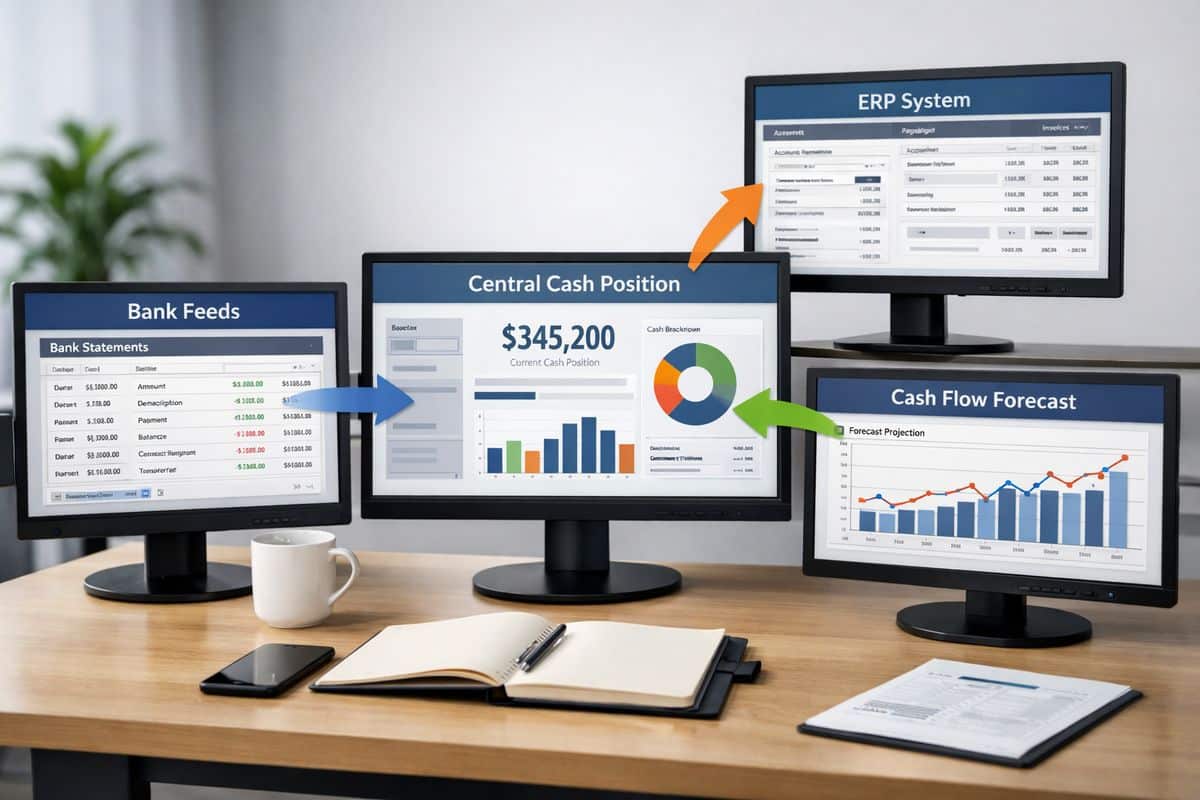
Cash positioning brings your balances together across accounts and entities into one consolidated view. That is where visibility becomes useful.
Instead of checking separate portals and files, you see current cash, near-term inflows, committed outflows, debt exposure, and liquidity headroom in one reporting structure. Live dashboards make that information usable for decision-makers, not just finance staff. Role-based visibility matters here. A controller needs detail. A CFO needs trend, exposure, and action points.
If you are building out that reporting layer, it helps to understand which finance metrics deserve dashboard space so your team tracks signals that drive decisions rather than clutter.
Forecasting, KPIs, and Scenario Modelling
Visibility becomes actionable when it connects to rolling forecasts, working capital KPIs, and scenario models.
Useful measures include cash runway, DSO, DPO, ageing, forecast variance, net debt, and operating cash flow margin. Paystand notes that an operating cash flow margin above 15% signals strong cash conversion, while below 8% points to collection or working capital issues. Those are not abstract finance ratios. They tell you where cash discipline is holding and where it is slipping.
Scenario modelling matters just as much. If collections slow by 10 days, if supplier terms tighten, if payroll rises, if borrowing costs increase, you need to see the cash effect quickly. That is what modern finance teams are expected to deliver.
How to Improve Cash Flow Visibility in Practice
Improvement starts when you stop treating cash as a report and start treating it as a connected operating system.
Connect Your Data Sources
Your ERP, accounting platform, bank feeds, billing tools, payroll systems, and operational data need to work together. If each system holds part of the truth, you do not have visibility. You have fragments.
Finance, technology, and operations have to run as one connected model. That is the only way to turn raw transactions into reliable live cash insight.
Standardise Categories and Reporting Rules
If entities classify flows differently, your group view is unreliable from the start.
Standardise category structures, forecast lines, timing rules, assumptions, and KPI definitions across the business. That prevents double-counting, missed flows, and reporting arguments every time numbers roll up to group level. Consistency is what makes comparison, consolidation, and action possible.
Automate the Manual Work
Automation should handle bank feeds, reconciliations, recurring reports, forecast refreshes, and dashboard updates. Your finance team should spend less time collecting data and more time interpreting it.
The gains are practical: fewer errors, faster close-to-insight cycles, better auditability, and less dependency on key individuals. That is why businesses investing in smarter accounting automation move faster without adding proportional admin overhead.
Build a Dashboard That Supports Decisions
A useful cash dashboard shows the current cash position, short-term runway, receivables, payables, forecast variance, entity-level performance, and scenario views. It should answer the next business question immediately.
Can you fund planned growth? Where is cash trapped? Which entity needs attention? How far does liquidity stretch under pressure? If the dashboard cannot support those decisions, it is decoration.
Common Questions About Cash Flow Visibility
Is Cash Flow Visibility Only for Larger Companies?
No. Complexity creates the need, not size alone.
A fast-growing SME with multiple systems, multiple accounts, international suppliers, or more than one entity already needs connected visibility. If you are expanding, borrowing, or managing tighter margins, delayed cash insight is already costing you.
Is a Cash Flow Statement Enough?
No. A cash flow statement is essential, but it is historical.
Visibility requires current balances, timely bank data, forward-looking forecasts, operational context, and consistent reporting rules. The statement tells you what happened. Visibility tells you what demands action now.
What Results Should You Expect From Better Visibility?
Expect fewer surprises, stronger borrowing decisions, tighter supplier and customer management, more credible stakeholder reporting, and better use of working capital.
More importantly, expect a different way of running the business. Once cash is visible, finance stops being a rear-view mirror. It becomes a control tower. That is the real shift, and it is why businesses that get this right operate with more speed, more confidence, and far more control.
Leave a Reply