
If you trade across borders, the question is not whether Xero multi currency works. It does. The real question is whether it gives you enough control for the way your business actually operates. This guide cuts through the feature list and shows where Xero handles international accounting well, where it starts to strain, and what to check before you commit.
What Xero Multi-Currency Actually Does
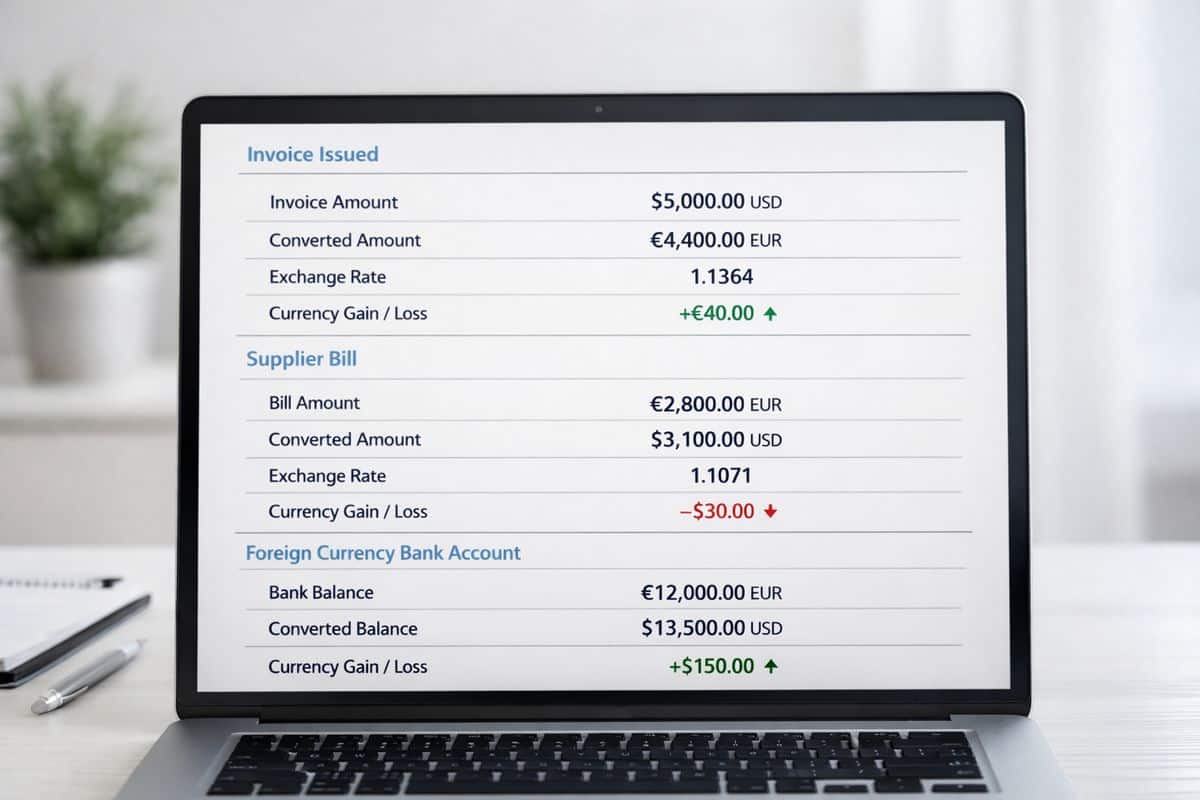
Xero multi currency is built to let you invoice, bill, reconcile, and report in foreign currencies without pushing everything into spreadsheets. At a practical level, that means you can send an invoice in USD, receive a supplier bill in EUR, hold a foreign bank balance, and still keep your base-currency books accurate.
The appeal is automation. Xero supports transactions in over 160 currencies and updates exchange rates hourly using XE.com data. That matters because multi-currency accounting breaks down fast when exchange rates are static, entered manually, or applied inconsistently across invoices, bills, and bank movements.
For an SME in Cyprus or Greece, that usually translates into cleaner records for imports, exports, overseas services, and contractor payments. You get one ledger that reflects operational reality instead of a patchwork of accounting entries and off-system currency adjustments.
The Core Features That Matter Day to Day
The day-to-day features are straightforward, which is exactly why Xero works well for many growing businesses. You can assign a default currency to a contact, so overseas customers and suppliers do not need the same settings entered again and again. You can raise invoices and enter bills in the contact’s currency. You can connect foreign-currency bank accounts and reconcile transactions against the right balances.
Xero also allows manual rate overrides. That is useful when a bank applies a specific conversion rate or when a contract sets a fixed exchange rate. Used properly, that keeps transaction records aligned with commercial reality. Used carelessly, it creates reporting noise. More on that later.
Another strong point is automatic FX accounting. Xero tracks unrealised gains and losses before settlement and posts realised differences when payment lands, including to its Foreign Currency Gains and Losses account. That removes a lot of month-end clean-up and gives finance teams a clearer view of what was earned operationally versus what moved because of currency shifts.
What You Get From the Premium Tier
Multi-currency is not usually available on Xero’s entry-level plans. Access generally sits on the higher subscription tier rather than as a separate add-on, which makes this a buying decision about capability and cost, not a small feature toggle.
That pricing structure is fair if international activity is part of normal operations. If you invoice overseas customers every month, buy from foreign suppliers, or hold non-EUR balances, the time saved usually justifies the upgrade. If you are still evaluating the wider platform, it helps to understand how a Xero rollout usually unfolds before treating plan cost as the only decision point.
When Xero Multi-Currency Is Enough for Your Business
Xero is enough when you need reliable multi-currency accounting, not a full treasury system. That is the dividing line.
If your business has standard cross-border activity and you want clean books, automated FX handling, and useful reporting, Xero does the job well. If your finance team is not running complex payment operations, hedging strategies, or multi-entity consolidations across several jurisdictions, you do not need to overbuy.
This is where Xero is strongest: practical international accounting for SMEs that need visibility and control without ERP-level complexity.
Best-Fit Business Profiles
Xero is a strong fit if you import stock or materials from overseas suppliers and need bills recorded in supplier currency. It also fits businesses that invoice customers abroad, especially service companies working across the EU, the UK, and the Middle East.
It works well when you pay international contractors or freelancers but do not run a large-scale global payroll or mass payables operation. It also makes sense when you hold a limited number of foreign-currency accounts and want your accounting platform to mirror real bank positions without manual translation work.
In short, Xero fits operationally active SMEs with international touchpoints, not finance-heavy organisations building specialist treasury infrastructure.
Operational Wins You Can Expect
The immediate win is less manual data entry. Exchange rates update automatically, gains and losses are tracked for you, and reconciliation becomes faster because transactions are already sitting in the correct currency context.
The second win is visibility. Xero states that 88% of customers in a UK small business survey said it improves financial visibility. That aligns with how multi-currency actually works in practice: cleaner FX data gives you a more accurate view of margins, liabilities, and cash flow.
Month-end also improves. Instead of chasing rate differences across spreadsheets, you review structured reports and investigate exceptions. If your wider goal is live control over finance operations, the bigger gains usually come when accounting is combined with smarter automation inside Xero, not treated as a standalone bookkeeping tool.
The Buying Criteria: How to Judge Whether Xero Is Sufficient
The right buying question is not “Does Xero have multi-currency?” It is “Does Xero cover the real complexity in your business?” Those are not the same thing.
Transaction Volume and Currency Complexity
Occasional international payments are easy. Constant cross-border activity is not. If you deal with two or three foreign currencies, a manageable number of monthly invoices and bills, and a small set of overseas counterparties, Xero remains efficient.
Complexity rises fast when currency exposure becomes continuous. More supplier payments, more foreign accounts, more settlements, more exceptions. Once that happens, the accounting entry becomes only one part of the process. Payment timing, FX spreads, bank routing, approval control, and transaction status start mattering just as much.
That is the point where you stop evaluating software by feature list and start evaluating it by operational throughput.
Reporting, Compliance, and Finance Control
A proper multi-currency setup must produce reliable balance sheets and profit and loss reports in base currency while preserving visibility into the originating foreign amounts. It also has to separate unrealised FX movements from realised ones so your month-end and audit trail stay clean.
Xero handles this well for standard SME reporting. You can run local or foreign currency reports and monitor exposure without building custom workarounds. For a financial controller, that is enough when oversight is focused on one entity or a simple structure.
The pressure increases when approvals, payables control, and reporting need to connect tightly across teams. At that point, accounting accuracy is only half the requirement. Workflow control starts to matter just as much, especially if your current process still depends on email approvals and off-system decisions.
Payments, Fees, and Treasury Requirements
Here is the key distinction: accounting for international transactions is not the same as moving money internationally.
Xero records foreign-currency activity well, but it does not solve bank fees, poor FX spreads, payment delays, or treasury strategy on its own. If your pain point is execution rather than accounting, the ledger is not the problem.
This matters because many businesses buy multi-currency accounting expecting cheaper international payments. That is the wrong expectation. Xero tells you what happened financially. It does not act as your cross-border payments engine.
Where Xero Multi-Currency Delivers Real Value
Xero earns its place when you want a connected, cloud-based finance system that keeps international activity visible and manageable. That is exactly why multi-currency has become a standard buying criterion in modern accounting software, with cloud-based solutions holding 60% of the market.
Automated FX Handling That Reduces Admin
The strongest value is the removal of repetitive FX admin. Hourly rate updates, automatic conversions, and built-in gain and loss handling reduce the need for manual calculations and side spreadsheets.
That saves time, but more importantly, it reduces inconsistency. Finance teams stop inventing their own methods for conversions and corrections. Reconciliation gets faster, errors drop, and month-end becomes more controlled. If bank matching still feels slower than it should, tightening your reconciliation workflow usually unlocks more value from the same system.
Multi-Currency Reporting for Better Decisions
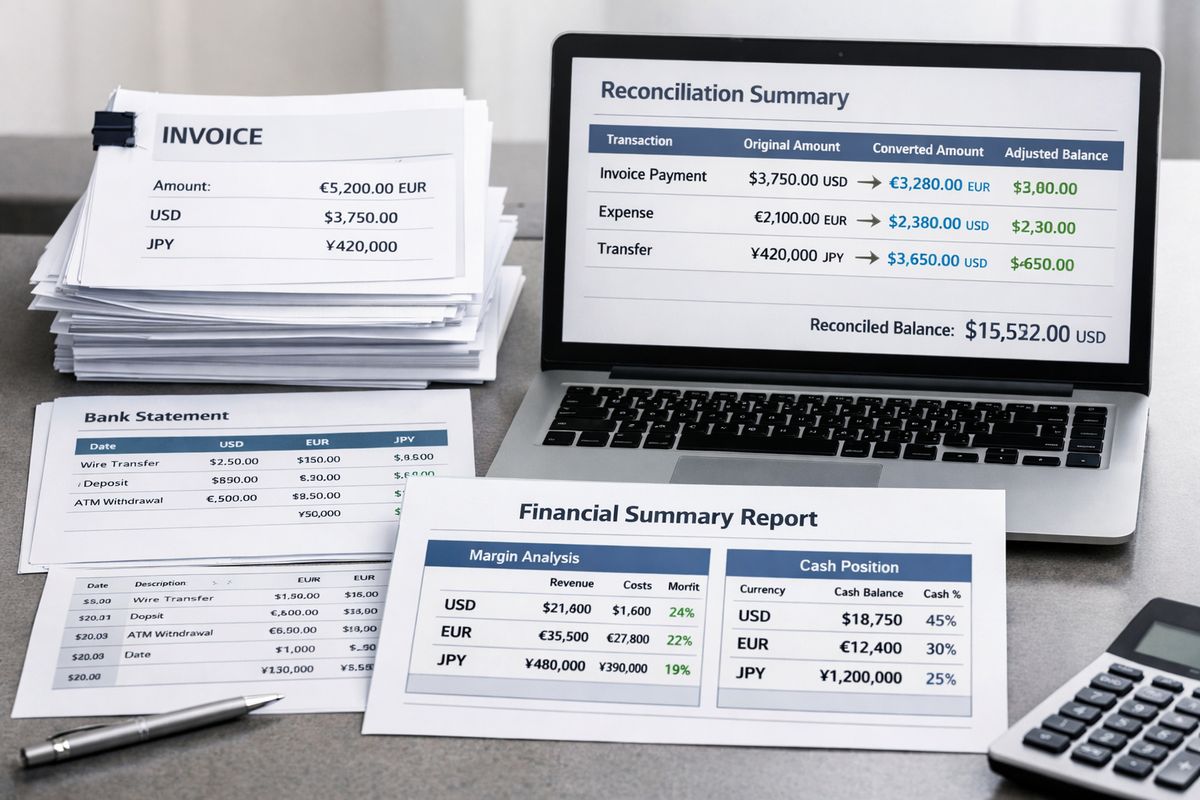
Good reporting is where multi-currency stops being a bookkeeping feature and starts becoming a management tool. With current FX data reflected in the ledger, you get a clearer picture of actual margin, outstanding liabilities, and cash positions across currencies.
That improves forecasting and KPI tracking. You can separate operational underperformance from exchange-rate movement instead of blending both into one blurry result. For owners and CFOs trying to connect finance with operations, that clarity matters because decisions about pricing, supplier terms, and cash planning become grounded in current data, not delayed hindsight.
Where Xero Stops Being Enough
This is where the answer becomes decisive. Xero is strong at accounting. It is weaker at payment execution, group complexity, and advanced global finance control.
High-Volume International Payments
Once international payment volume rises, the bottleneck shifts. Entry and reporting are no longer the hard part. Payment fees, FX spreads, routing delays, and operational friction become the real issue.
That is where a payment layer such as Wise becomes valuable. The benefit is not replacing Xero’s accounting. The benefit is improving the movement of money and feeding cleaner data back into the ledger. Wise highlights automatic bank feeds and bill payments as part of that connection, which is exactly the kind of operational gap Xero alone does not close.
Multi-Entity and Group-Level Complexity
If you operate across multiple legal entities, intercompany flows, or more demanding group reporting structures, standard multi-currency functionality stops being enough on its own. You need stronger consolidation logic, cleaner entity separation, and better control over how data rolls up.
Xero can support some of this, but not at the level required for a fast-growing group with layered reporting and approvals. If that sounds familiar, it is worth reviewing what changes when your business runs across more than one entity, because the design of the finance stack becomes the real issue.
Advanced Global Finance Needs
Xero is not built to be a treasury platform. It does not give you FX hedging, advanced payables automation at scale, complex supplier payment orchestration, or enterprise approval management across global workflows.
If your finance team needs centralised control over payment batches, policy-driven approvals, or international supplier operations at volume, you need more than accounting software. You need a broader operating layer. That is exactly the type of finance-and-operations gap Prodyssey Solutions addresses by connecting Xero with process design, live reporting, and operational control.
Xero vs the Alternatives: Accounting Tool, Payment Layer, or Advanced Platform?
The smartest decision is not Xero versus no Xero. It is deciding what role Xero should play in your finance stack.
Xero Alone
Xero alone is enough if your business has straightforward international trading, limited currencies, moderate transaction volume, and no demand for sophisticated payment infrastructure. In that setup, Xero gives you the accounting backbone you need: invoicing, billing, reconciliation, FX tracking, and reporting.
That is a strong answer for many SMEs. Clean, fast, and proportionate.
Xero Plus Wise
This combination is common because the responsibilities are clear. Xero handles accounting and reporting. Wise improves cross-border payment execution, fee efficiency, and foreign-currency account handling.
If your books are fine but payment costs and admin feel heavy, this is often the right next step. You keep the accounting layer stable and strengthen the movement of money around it.
When to Move Beyond Xero
A more advanced platform becomes justified when growth creates operational friction that accounting alone cannot absorb. That includes multi-entity scale, heavy AP automation, global supplier networks, strict approval control, and finance teams that need workflows as much as they need ledgers.
At that stage, your problem is not software capability in isolation. Your problem is system architecture. Accounting, approvals, payables, dashboards, and operational workflows need to work together.
Common Multi-Currency Setup Mistakes That Create Reporting Problems
Many reporting issues blamed on Xero are actually setup mistakes. The software is usually not the problem. The structure is.
Using the Wrong Bank Account Structure
Foreign balances should sit in matching foreign-currency bank accounts inside Xero. If you map a foreign bank feed into a base-currency account, your balances and reconciliation logic become distorted immediately.
That error usually creates confusion at month-end, especially when finance teams try to explain balance movements that are really setup defects. Xero guidance also stresses selecting the correct currency when the bank account is created. The wider lesson is simple: fix the structure early, or reporting quality drops from day one. The same pattern shows up in many poorly designed implementations.
Overriding Exchange Rates Without a Clear Reason
Manual rate overrides should only be used when you have a contractual fixed rate or a bank-applied rate that differs from the standard feed. Outside that, overriding rates weakens consistency.
The problem is not one invoice. The problem is cumulative distortion. If different users override rates casually, your FX analysis becomes less reliable, realised and unrealised movements get harder to interpret, and management reporting loses trust. Automation only works when your team respects the logic behind it.
Is Xero Multi-Currency Enough for Your Business?
For many SMEs, yes. For internationally active businesses with standard accounting needs, Xero multi currency is strong, efficient, and worth paying for. It gives you visibility, automation, and cleaner reporting without overcomplicating your finance stack.
Xero Is Enough If…
You are operating at SME scale, trading internationally in a manageable number of currencies, and handling standard invoicing, supplier bills, and foreign bank accounts. You want better visibility, faster reconciliation, and more accurate month-end reporting. You need strong accounting control, not specialist treasury infrastructure.
Xero Needs Support If…
Your international payment volume is rising, transfer costs are under pressure, or your finance team is spending too much time pushing payments through fragmented banking processes. You operate across multiple entities, need tighter approval control, or require advanced automation beyond the ledger. In that situation, keep Xero at the core, then extend it with the right payment and workflow layer so finance, operations, and decisions stay connected.
Leave a Reply