
Automation adoption means your team uses automation as the normal way work gets done. Not occasionally. Not when the project manager is watching. Not only inside finance. If you want better control over cash flow, approvals, reporting, and operations, automation adoption is the part that actually delivers the result.
What Automation Adoption Actually Means
Automation adoption is not the moment you buy software, switch on a workflow, or finish an implementation project. It is the point where your finance, operations, and admin teams trust automated workflows enough to use them every day without slipping back into email chains, spreadsheets, and manual follow-ups.
That distinction matters more than most businesses admit. You can have excellent tools and still run a manual company. You can have connected systems and still rely on staff to rekey data, chase approvals, and patch gaps between departments. In that situation, you have automation capability, not automation adoption.
For SMEs in Cyprus and Greece, this is not a technical nuance. It is the difference between seeing the business in real time and managing it through delay. Platforms such as Prodyssey Solutions are valuable because they connect finance, technology, and operations into one working model. That is what adoption requires: a system that fits how your business actually runs.
Why tool rollout is not the same as adoption
A rollout changes technology. Adoption changes behaviour.
That gap is where most automation projects lose momentum. Teams keep the old spreadsheet because it feels safer. Managers continue approving through WhatsApp or email because it feels faster. Operations staff update one system but not the others because nobody trusts the integration. The process looks automated on paper, but the daily reality stays manual.
Research backs this up. In PwC’s operations survey, user adoption challenges, data issues, and integration complexity all showed up as barriers. That is not a software problem alone. It is a workflow, trust, and management problem.
Why this matters for finance-led businesses
If you lead from finance, poor adoption hits where it hurts: delayed invoicing, weaker approval control, patchy reporting, and slower month-end close. You do not get live visibility if the workflow still depends on somebody remembering to send a file or update a sheet.
Strong automation adoption gives you something much more useful than speed. It gives you control. Approvals happen through rules. Data moves into the right place at the right time. Exceptions stand out. Audit trails exist by default. KPIs stop being historical guesses and start reflecting what is happening now.
That is especially valuable in growing businesses where accounting and operations need to move together. If stock, projects, jobs, purchasing, billing, and cash collection live in separate worlds, finance is always reacting late.
Why Teams Resist Automation Even When the Business Case Is Clear
Teams do not resist automation because they love manual work. Teams resist bad automation because bad automation creates confusion, extra steps, and risk.
Fragmented systems create friction and kill trust
Most businesses are not running one neat platform. They are running accounting software, spreadsheets, inbox approvals, CRM records, payroll tools, stock systems, and industry-specific apps. That fragmented setup is normal. In fact, 88% operate in hybrid IT, and 89% manage multiple automation platforms.
The problem is not having more than one system. The problem is asking staff to work across disconnected systems without a reliable control layer. Once one workflow breaks between accounting, inventory, CRM, or approvals, trust drops immediately. From that point on, your team starts building manual workarounds. Manual workarounds become the real process.
Poor workflow design keeps manual work alive
Automating one task inside a broken process does not fix the process. It just automates one broken step.
Here is where many projects go wrong. You automate invoice entry, but approval still happens by email. You automate stock alerts, but purchasing ownership is unclear. You automate job updates, but project costing is still delayed because field data arrives late. Nothing really changes because the workflow, meaning the sequence of actions, handoffs, and decisions, is still weak.
MIT Sloan’s research on workflow redesign makes the point clearly: value shows up at workflow level, not just task level. If you want adoption, design the whole chain.
If automation is hard to access, teams will ignore it
People use what is easy.
If automation lives inside a specialist console that only a few people understand, adoption stays low. If it appears inside the approval flow, ERP screen, portal, form, or familiar tool your team already uses, adoption rises fast. Stonebranch found that familiar tools such as ITSM and self-service portals now outperform native interfaces for access.
That result makes perfect sense. Your team does not want another place to log in. Your team wants fewer steps, clearer actions, and visible status.

The 4 Conditions That Get Teams to Actually Use Automation
Adoption becomes predictable when four conditions are in place. Miss one and usage drops. Miss two and the project turns into shelfware.
Start with one operational pain point that already costs you money
Do not begin with a platform demo. Begin with a weekly business problem.
Pick the issue that is already visible in numbers and frustration: delayed invoicing, purchase approvals stuck for days, poor stock updates, project costing lag, or order-to-cash delays. When the problem is obvious, the benefit is obvious too. Teams use automation when it removes a pain they already feel every week.
If you need a sharper starting point, it helps to focus on where SMEs save time fastest. The best early win is not the most impressive workflow. It is the one your business is already paying for in delay, leakage, or rework.
Build automation into the workflow, not beside it
Automation must sit inside the existing process, role structure, and approval chain. If it feels like an extra step, it will be skipped.
That means triggers should happen automatically. Data should update across systems without manual re-entry. Alerts should appear when action is needed, not after the delay has already caused damage. Handoffs should be designed, not left to habit.
For businesses trying to connect finance and delivery, this is where linking accounting with operational workflows becomes decisive. The real gain is not isolated efficiency. It is one connected process from event to decision to financial impact.
Make usage simple, visible, and self-service
Adoption rises when people can see what happened, what is waiting, and what needs action. That sounds basic, but most automation projects underdeliver here.
Your team needs dashboards, status tracking, alerts for exceptions, and simple actions such as approve, reject, escalate, or correct. No hunting through inboxes. No asking finance for updates. No hidden steps only one person understands.
Self-service matters because it removes dependency. Research shows that more than 200 users are already being supported in many organisations through self-service automation models. That is the direction of travel. Adoption scales when access is simple and controlled, not centralised and slow.
Set clear rules, ownership, and governance
Every automated workflow needs an owner. Not a committee. A named owner.
That workflow also needs approval logic, escalation rules, data standards, and exception handling. Without those controls, automation creates inconsistency faster than people do. With those controls, automation strengthens oversight, audit readiness, and operational discipline.
This is also where many businesses ignore obvious dangers until they become expensive. If governance is weak, the same issues appear every time: duplicate steps, unclear accountability, bad data, and approval confusion. That is why understanding what causes automation projects to fail is not optional once usage starts scaling.
Where Automation Adoption Delivers the Fastest Value
The fastest value appears where finance and operations touch each other every day.
Finance and approvals
This is usually the first area where adoption pays back. Purchase requests, invoice matching, expense controls, collections reminders, payment approvals, and month-end checks all benefit from defined rules and visible status.
The result is straightforward: fewer delays, fewer manual errors, tighter spend control, and stronger cash flow visibility. Instead of waiting for someone to chase an approval, you see what is blocked and why. Instead of discovering an issue at month-end, you catch it in the workflow.
For many SMEs, that is the real case for proving financial return from automation. Better process speed matters, but control over cash, liabilities, and exceptions matters more.
Operations and service delivery
Operations usually suffers from hidden manual work. Jobs are scheduled in one place, stock is tracked somewhere else, and the financial impact appears later if it appears at all.
Automation improves service delivery when job scheduling, order processing, replenishment, project tracking, field updates, and customer handoffs run through connected workflows. Bottlenecks become visible. Missing updates stand out. Managers stop relying on verbal updates and start using live status.
That is where businesses feel the shift from administration to control.
Reporting and decision-making
Static reports do not drive adoption. Live dashboards do.
Teams use automation more consistently when they can see the result in margin tracking, overdue actions, approval volumes, project status, budget usage, and cash indicators. Reporting stops being backward-looking and starts directing action in the moment.
This is exactly why finance operations and system design have to move together. A disconnected reporting layer only tells you what already went wrong. A connected one gives you a management system.
How to Roll Out Automation Without Triggering Pushback
Rollout is not an IT event. It is a management discipline.
Show teams exactly what changes in their day-to-day work
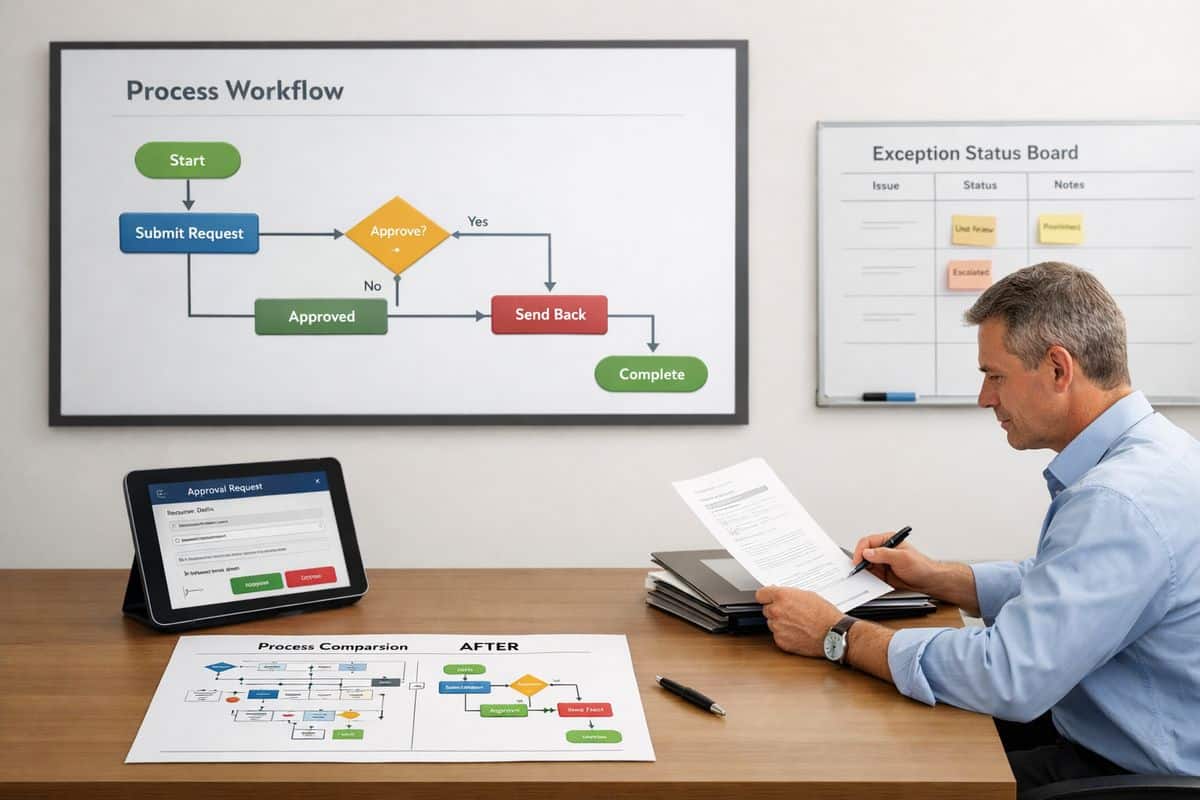
Spell out the old process and the new one. Show what stops, what starts, what becomes automatic, and what still requires judgement.
That level of clarity removes most resistance before it starts. When people understand that the new process cuts manual chasing, reduces duplicate entry, and makes accountability clearer, adoption becomes far easier. Confusion is the real enemy, not change itself.
Train for action, not for features
Feature-heavy training is a waste of time. Your team does not need a product tour. Your team needs to know how to approve, review, escalate, correct exceptions, and read dashboards inside the real workflow.
Short, role-based training works because it matches actual work. So does reinforcement after launch. If you want automation to stick, focus on operational behaviour, not software menus. Strong adoption-focused change management turns a rollout into a working habit.
Track usage, exceptions, and business outcomes from day one
If you do not measure usage, you are guessing. If you do not measure business outcomes, you are storytelling.
Track workflow completion rates, approval times, exception volumes, overdue tasks, rework, and days saved. Then tie those numbers back to cash flow, close speed, service quality, and management visibility. Boards and CFOs are already demanding hard proof of business impact within months, not years. That discipline is healthy. It keeps automation grounded in results.
Common Misconceptions About Automation Adoption
Some bad assumptions keep showing up, even in businesses with strong systems and serious budgets.
“Once the system is live, the team will use it”
No. Go-live is the starting line.
Implementation changes the technology environment. Adoption changes the operating model. If ownership, workflow redesign, training, and reinforcement are missing, the team will default to old habits and the new system will become an expensive side channel.
“Automation removes the need for human control”
The opposite is true. Good automation increases control because it applies rules consistently, routes approvals properly, records every action, and flags exceptions immediately.
Manual processes hide mistakes. Automated workflows expose them. That is why finance-led businesses benefit so much from adoption: oversight gets stronger, not weaker.
“AI adoption means automation maturity”
Using AI tools is not the same as running a mature automated business. Plenty of teams experiment with AI. Very few have embedded it into governed, cross-functional workflows that deliver repeatable results. Research shows only 21% reached enterprise scale in AI workflow deployment.
That is the right reality check. Buying AI features does not give you operational maturity. Governance, workflow design, ownership, and team usage do.
What Actually Changes Once Your Team Uses Automation Properly
Once adoption is real, your business stops running on follow-up and starts running on flow. Approvals move with rules. Exceptions stand out early. Finance sees operations sooner. Operations sees financial impact sooner. Reporting becomes live enough to manage with, not just review afterwards.
That is the real promise of automation. Not more software. Better business control. And for any SME trying to connect accounting, operations, and decision-making into one clear system, that is where the value finally becomes visible.
Leave a Reply