
Month end bookkeeping is the process of turning one month of business activity into accurate, complete, decision-ready financials. If that process runs slowly, your decisions run slowly too, because you are steering the business with numbers that already belong to the past.
What Month-End Bookkeeping Actually Means
Month-end bookkeeping is not just entering invoices and matching bank transactions. It is the disciplined process of closing off the previous month so your profit and loss, balance sheet, cash position, and operating KPIs reflect what actually happened. That means your numbers are no longer provisional, half-posted, or full of gaps.
Routine bookkeeping happens throughout the month. Transactions get recorded, bills are posted, customer receipts are allocated, and bank feeds pull through activity. Month-end bookkeeping takes that raw activity and checks it properly. It is the point where incomplete records become financial information you can trust.
That is different from management reporting, which sits on top of the close. The close produces the verified data. Management reporting turns that data into insight, such as margin by division, debtor trends, budget versus actuals, and live operational performance. If the close is weak, every dashboard and board pack built on top of it is weak as well.
What happens during the month-end close
A proper close includes more than a quick bank reconciliation. You need final transactions posted, bank and balance sheet accounts reconciled, receivables and payables reviewed, payroll checked, accruals and prepayments entered, and unusual movements investigated. Then financial statements are produced and key performance metrics are reviewed against plan.
Some of this work looks technical, but the purpose is simple: your accounts need to reflect economic reality, not just what happened to clear the bank by month-end. Unbilled revenue, unpaid expenses, deferred costs, payroll liabilities, intercompany balances, and stock movements all matter. Without those adjustments, your monthly results are neat-looking but wrong.
Why this process matters beyond compliance
Many businesses still treat month-end as an accounting admin task. That is the wrong lens. Month-end bookkeeping is a control process that gives you visibility over cash flow, profitability, cost drift, and operational performance while the information still matters.
When the close is done properly, you can spot margin pressure before it becomes a quarterly surprise. You can see if debtor balances are stretching, if spend is running ahead of budget, or if one location is outperforming another. That is why Prodyssey Solutions frames accounting as a live business control system, not a backward-looking compliance file.

Why Slow Month-End Bookkeeping Slows Better Decisions
A delayed close creates delayed visibility. Delayed visibility creates hesitation, slower action, and weaker commercial judgement. That is the real cost of slow month end bookkeeping.
Finance teams often talk about close speed as an internal efficiency issue. For leadership, it is a decision issue. If your management accounts arrive halfway through the next month, you are using old information to make current decisions on hiring, pricing, purchasing, and cash allocation.
Your numbers are already old when you use them
A five-day close already means you start the new month with last month still unresolved. A 10-day or 14-day close is worse. You are then managing April using March numbers long after trading conditions have changed.
This is not unusual. Research shows only 16% under three days for the monthly close, while large numbers of finance teams take far longer. In professional services firms between $1 million and $10 million revenue, the average close runs to 14.2 business days. At that point, your reports are not current. They are historical commentary.
That is why many firms are moving towards finance that updates in real time. The aim is not just speed for its own sake. The aim is fresher numbers that support action before the opportunity or problem has passed.
Late closes weaken cash flow, forecasting, and KPI control
Cash flow suffers first. If receivables are reviewed late, overdue accounts are chased late. If supplier liabilities are not fully captured, your cash forecast is wrong. If payroll accruals or prepaid costs are missing, your margin analysis is distorted.
Forecasting gets weaker for the same reason. Actuals are the base layer of any forecast. If actuals are incomplete or delayed, forecast revisions become guesswork dressed up as planning. Budget-versus-actual analysis loses value too, because by the time the variance is reviewed, the next month is already underway.
The same applies to KPIs. Sales, gross margin, overhead run rate, project profitability, stock turns, and debtor days all depend on timely close discipline. Better visibility over cash movement and obligations changes the quality of day-to-day decisions because you stop relying on instinct and bank balance snapshots.
Fragmented reporting creates hesitation at leadership level
The slowest part of month-end is rarely one hard accounting rule. It is the friction between systems, spreadsheets, and departments. Finance waits for stock numbers, expense claims, payroll journals, project updates, supplier invoices, revenue cut-off information, and approval sign-offs. Then the checking starts.
That fragmentation creates a confidence problem. Every number needs another review. Every variance needs a side spreadsheet. Every board pack needs caveats. Once leadership loses trust in the numbers, decisions slow down because nobody wants to act on information that may change tomorrow.
What Actually Causes Month-End Delays
Slow closes are usually blamed on workload. The real cause is process design. Manual handoffs, inconsistent coding, disconnected systems, and poor visibility into status create delay long before capacity becomes the issue.
Manual reconciliation and spreadsheet-heavy workflows
Many businesses have cloud accounting software but still run month-end through spreadsheets. Transactions are exported, reworked, cross-checked, recoded, and manually matched. Reconciliations depend on individual effort instead of system rules and exception-based review.
That is why month-end remains slow even after software upgrades. Research shows about 80% still manual for repetitive tasks such as data entry, categorisation, and reconciliation. Cloud access alone does not remove manual finance work.
Waiting on data from other systems and departments
Finance cannot close what the business has not supplied. If stock data arrives late, revenue schedules are incomplete, payroll changes are unconfirmed, or managers sit on approvals, the close stalls. This is the most common bottleneck in practice.
The data supports that. Nearly 8 in 10 finance professionals report close delays caused by waiting for information from other systems or departments. Month-end speed is not just an accounting problem. It is an operating model problem.
Multi-entity complexity and cross-system consolidation
If your business has multiple entities, branches, locations, cost centres, or reporting lines, month-end gets harder fast. Intercompany balances need to match. Eliminations need to be posted. Coding structures need to be consistent. Reports need to consolidate correctly across more than one ledger or source system.
This is where delays multiply. A simple posting error in one entity becomes a group reporting issue. A local workaround becomes a consolidation headache. Without a standard structure, month-end becomes a monthly repair job.
Cloud software without real automation
There is a common assumption that moving to cloud accounting fixes the close. It does not. Plenty of businesses have bank feeds, online access, and digital invoices, yet still close slowly because approvals happen offline, reconciliations are manual, and management reporting depends on spreadsheet consolidation.
That is why accounting workflows built for automation matter more than software logos. Better outcomes come from connected processes, ownership, and rules-driven review, not from adding another tool to the same broken month-end routine.
What Better Finance Teams Do Differently
The best teams do not wait until month-end to discover problems. They run a controlled, continuous process that reduces surprises, clears exceptions early, and keeps finance aligned with operations.
Move from month-end scramble to continuous close
A continuous close means key accounts are reconciled during the month, not dumped into the first week of the next one. Recurring journals are prepared in advance. Supporting schedules are updated continuously. Exceptions are resolved while the underlying activity is still fresh.
This changes the rhythm completely. Instead of a monthly scramble, you get a shorter, cleaner final close. Benchmarks consistently show that teams with earlier reconciliations and documented close discipline finish faster and spend less time on rework.
Standardise tasks, owners, and deadlines
Fast closes are structured. Every task has an owner, a deadline, a dependency, and a review point. The sequence is clear. Cut-off rules are documented. Recurring journals are templated. Review notes do not live in somebody’s inbox.
That removes key-person dependency and stops work from stalling in hidden bottlenecks. It also makes outsourced and in-house support easier to coordinate because the process is visible and repeatable.
Build live visibility into exceptions and status
You should be able to see what is complete, what is overdue, and what is blocking the close without chasing ten people on email. Dashboards and workflow tools bring that visibility into one place, especially when finance systems connect properly with operations.
A useful finance dashboard built around the right KPIs does not just report after the close. It highlights exceptions before month-end becomes a bottleneck.
How Automation and Outsourced Support Speed Up the Close
Faster month-end bookkeeping comes from fixing the operating model. Automation removes repetitive work. Outsourced support adds capacity, control, and specialist oversight. Together, those changes shorten the close and improve reporting quality.
Where automation delivers the fastest return
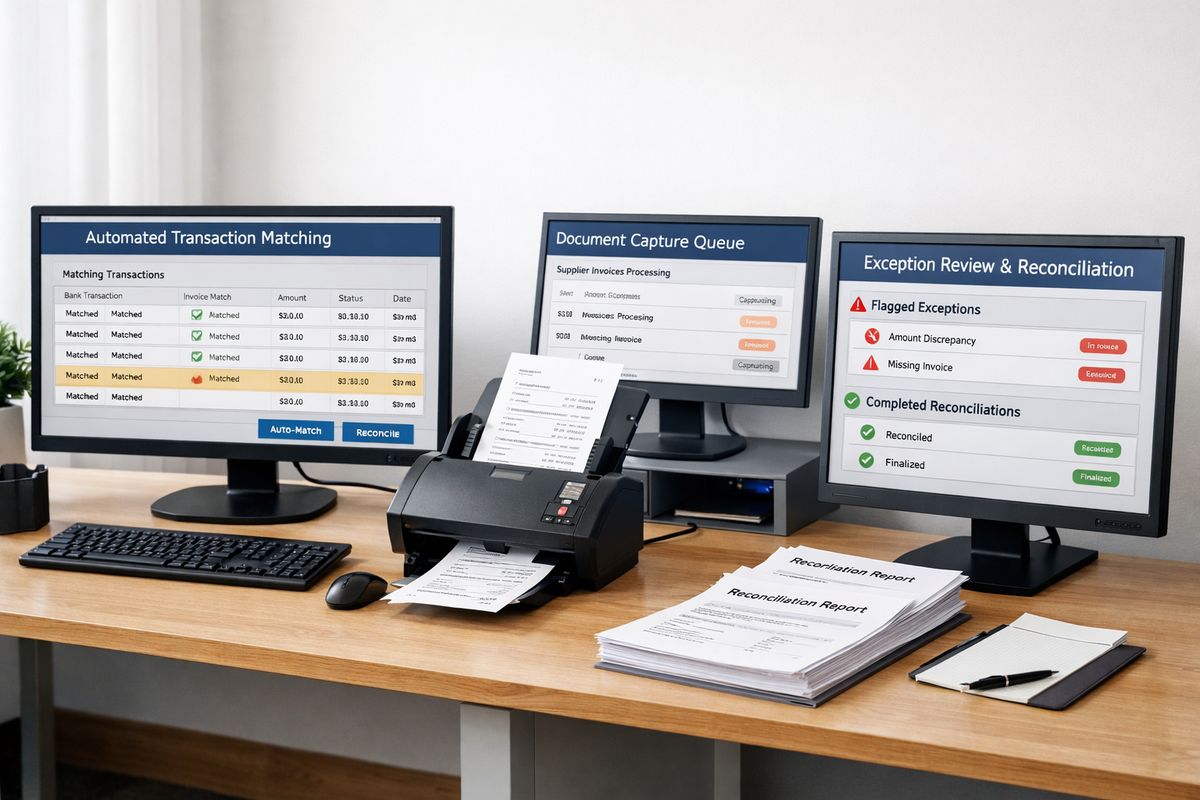
The best automation targets the most repetitive, time-consuming tasks first: reconciliation, transaction coding, accounts payable capture, consolidation, task routing, and exception handling. These are the areas where manual effort adds the least strategic value and creates the most delay.
The upside is substantial. Research found generative AI can cut the monthly close by 7.5 days and shift time away from routine processing into analysis. That matters because the goal is not to produce more admin faster. It is to free finance capacity for review, judgement, and commercial insight.
Why embedded AI matters more than standalone tools
AI adds value when it is built into finance workflows, not used only for drafting commentary or one-off analysis. If your team still exports data manually, chases approvals by email, and reconciles accounts outside the system, AI on top changes very little.
Embedded AI supports review by flagging anomalies, matching transactions, suggesting coding, and prioritising exceptions. Human judgement still decides the hard cases. That is exactly where finance should spend time.
When outsourced month-end bookkeeping becomes a strategic advantage
Outsourcing is no longer a stopgap for understaffed businesses. It is a way to improve close speed, reporting quality, and cost control without carrying unnecessary fixed overhead. That matters when a full-time bookkeeper can cost far more than salary alone once tax, software, management time, and supervision are included.
The trend is moving in that direction. Outsourcing is rising, and 67% of firms that outsource report faster close times. The advantage is strongest when you need both bookkeeping execution and controller-level discipline around process, reporting, and systems.
What Good Month-End Bookkeeping Should Deliver for Your Business
Good month-end bookkeeping should not feel like a monthly administrative event. It should function as a business control system that gives you timely numbers, stronger oversight, and faster commercial decisions.
Faster close, fresher reporting, stronger decisions
The target state is clear: reliable monthly financials delivered fast enough to influence the next decision, not explain the last mistake. You should be able to review performance while pricing, hiring, purchasing, and cash decisions are still active, not already locked in.
A faster close does not mean cutting corners. It means reducing manual effort, improving process discipline, and connecting finance with the rest of the business so the numbers arrive ready to use.
A practical checklist for assessing your current process
A simple test tells you a lot. Look at how long your close takes, how much reconciliation is manual, how many systems feed your accounts, where approvals stall, how often reports are restated, and whether leadership trusts the numbers on first review.
If the close depends on heroic effort, spreadsheet stitching, or repeated corrections, the process is under-designed. If reporting arrives late and decisions keep getting deferred, the close is already costing you more than finance time.
Questions business owners and finance leaders ask
A good monthly close should land within a few business days, not drift into the middle of the next month. Fast does not mean less accurate. In practice, the opposite is true, because strong process design reduces errors and rework. Automation should start where work is repetitive and high volume, especially reconciliations, payables capture, and consolidations. Outsourcing makes sense when internal finance is overstretched, reporting quality is inconsistent, or systems exist without proper control around them. At month-end, you should expect more than statutory-looking statements. You should expect a reliable profit and loss, balance sheet, cash position, budget comparison, and KPIs that leadership can use immediately.
Once you understand month end bookkeeping this way, the standard changes. You stop seeing the close as a finance deadline and start treating it as a speed-of-decision system. That shift is where better control begins.
Leave a Reply