
Real time accounting is a finance operating model where your numbers stay current throughout the month, not weeks after the fact. Instead of waiting for month-end packs to tell you what just happened, you see cash, costs, margins, and performance as they move, which gives you tighter control over the business and far better timing on decisions.
What Real-Time Accounting Means for Your Business
Real-time accounting replaces retrospective bookkeeping with continuously updated finance data. Transactions flow in daily, reconciliations happen as activity occurs, dashboards refresh automatically, and reporting reflects the current state of the business rather than a historical snapshot.
That changes the role of finance completely. Accounting stops being a record of what went wrong last month and becomes a live control system for what needs attention today. If you run multiple sites, projects, departments, or product lines, that visibility matters even more. You need to know which location is profitable now, which customer payments are slowing now, and where costs are drifting now.
For a growing business, this is not a cosmetic upgrade. It is the difference between steering through the windscreen and steering through the rear-view mirror. Month-end accounting tells you where you have been. Real-time accounting tells you what is happening while you still have time to act.
Why Month-End Is Too Late
Month-end reporting arrives after the commercial impact has already landed. By the time you spot a cash squeeze, stock issue, overdue debtors problem, or margin drop, the business has already absorbed the damage. That delay is not an admin issue. It is a control failure.
This is exactly why delayed finance teams struggle to support growth. Research cited by Cherry Bekaert found that 89% of CFOs make monthly decisions using inaccurate or incomplete data. If your reporting cycle lags behind operations, pricing decisions are slower, hiring decisions are less confident, and capital gets allocated with less precision than it should.
Month-end still has a role in formal close and sign-off. But using month-end as your primary management view no longer works. If you want sharper business control, start by understanding why delayed bookkeeping slows decisions.
How Real-Time Accounting Works in Practice
Real-time accounting works by keeping the data pipeline active all month. Sales, supplier invoices, expenses, bank movements, payroll inputs, and operational metrics feed connected systems continuously. Reconciliations and routine postings happen in the background. Exceptions rise to the surface for review instead of burying finance teams in repetitive processing.
The point is not to create more reports. The point is to reduce the lag between business activity and financial visibility. Once the lag disappears, finance becomes operational.
Cloud Systems Create the Live Data Flow
Cloud accounting platforms, ERP systems, bank feeds, and app integrations form the foundation. Without that infrastructure, your numbers stay trapped in desktops, spreadsheets, inboxes, and disconnected tools. With it, data moves automatically between functions and becomes visible across the business.
The market has already moved in that direction. Cloud deployment accounted for 61.72% of the market in AI-driven accounting in 2025, because cloud environments support live data exchange, continuous updates, and integrated workflows far better than on-premise systems. Separate systems and spreadsheet-led processes simply cannot keep pace with businesses that need current information every day.
This is where system design matters. Accounting software on its own is not enough. You need clean connections between banking, invoicing, payroll, inventory, reporting, and operational tools so your finance data reflects reality as it changes.
Automation Keeps Transactions Moving
Automation handles the repetitive work that normally creates month-end bottlenecks. Bank matching, invoice capture, expense processing, approval routing, recurring journals, and routine postings can all move through rules-based workflows with far less manual intervention.
That improves speed, but speed is only part of the value. Automation creates consistency. Transactions are coded the same way, approvals follow the same path, and reconciliations happen before backlog builds up. According to market research, 81% of accounting professionals report faster reconciliation after moving to cloud-based platforms.
The operational impact is obvious. Your finance team spends less time chasing paperwork and correcting avoidable errors, and more time reviewing exceptions, monitoring performance, and supporting decisions. If you want to go deeper on the mechanics, it helps to understand how automated finance workflows are structured.
AI Turns Faster Processing Into Better Insight
Automation follows rules. AI recognises patterns, improves decisions inside those workflows, and flags what deserves human attention. That is the difference.
In practice, AI improves coding accuracy by learning typical ledger treatments, extracts invoice and receipt data from unstructured documents, highlights anomalies, supports forecasting, and prioritises exceptions based on risk or urgency. Research from Mordor Intelligence notes that invoice data extraction now exceeds 95% accuracy, and early adopters of AI-enabled invoice handling reported a 30% reduction in processing times.
That matters because faster processing on its own just gives you faster admin. AI turns that faster processing into better visibility, better forecasting, and more reliable management insight. Finance teams using AI also report gains in efficiency, insight, and accuracy, which is why this is no longer a future-state discussion. It is becoming the standard operating model.
The Business Case: What You Gain When Finance Runs in Real Time
Real-time accounting earns its place when it changes business outcomes. Better control, faster action, and cleaner reporting all translate into measurable commercial value.
Stronger Cash Flow Control
Cash flow is the clearest use case because it changes daily. If you can see receivables, payables, upcoming obligations, and current bank positions in near real time, you manage liquidity proactively instead of reacting once pressure shows up in the bank balance.
That improves payment timing, reduces idle cash, and supports short-term planning with more confidence. AI-native cash-flow tools have helped trial customers reduce idle cash balances by 12% and avoid overdraft fees. For businesses with thin working capital margins, that is not a nice extra. It is protection.
Live visibility also changes behaviour. You chase debtors earlier, stage supplier payments more intelligently, and spot gaps before they turn into financing problems. That is why better visibility into cash has such a direct effect on control.
Faster Decisions With Live KPIs
Hiring, pricing, stock purchasing, marketing spend, supplier negotiations, and expansion plans all depend on current numbers. Waiting for end-of-month packs means you are making live decisions with stale information.
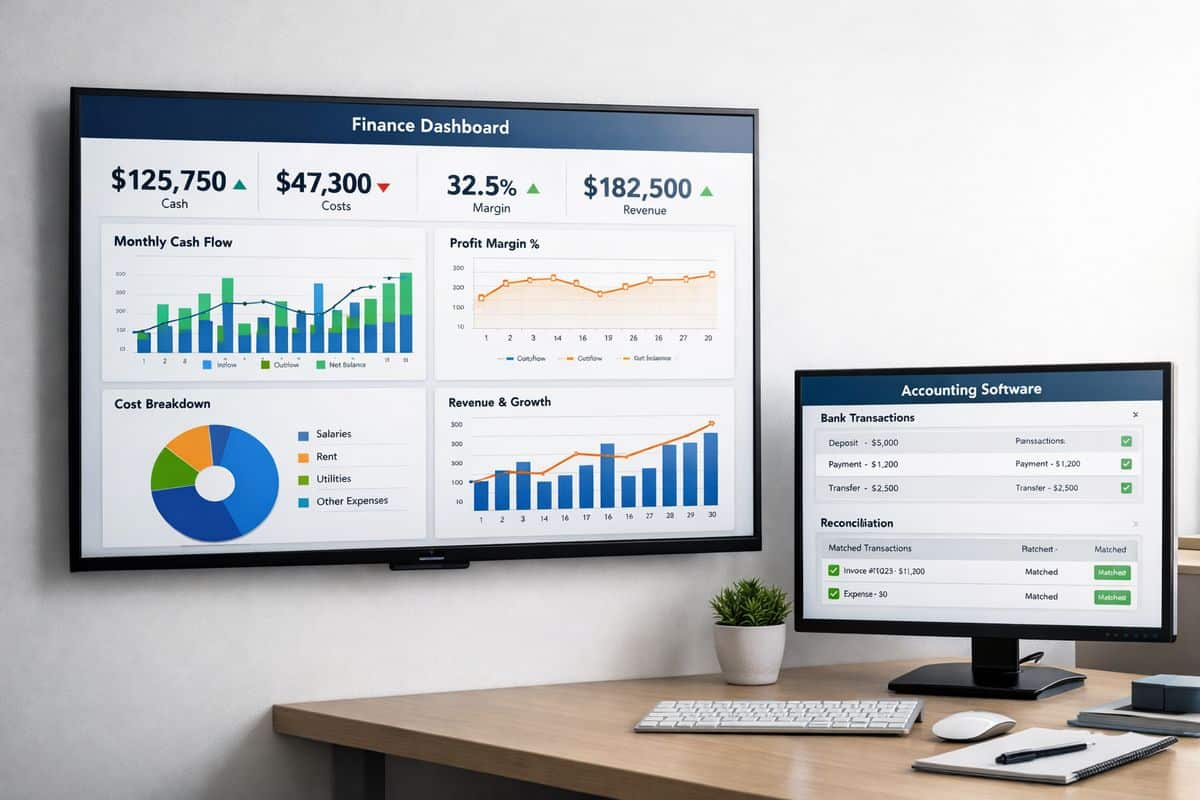
Real-time dashboards solve that by bringing the right KPIs into one connected view. Revenue trends, gross margin, debtor days, stock movements, budget variance, and project performance stay visible throughout the month. Industry research shows 69% of organisations prefer integrated dashboards with real-time analytics, which tells you exactly where finance expectations are heading.
Once you have current KPIs, management becomes more focused. You stop asking for broad reporting updates and start managing exceptions. What changed? Where is the variance? What needs action today? That is a far more effective operating rhythm than waiting for a bulky month-end pack.
Shorter Close Cycles and Fewer Errors
Real-time accounting does not eliminate period-end close, but it transforms it. When transactions are processed continuously, reconciliations are maintained throughout the month, and exceptions are resolved as they arise, close becomes shorter, cleaner, and less stressful.
You get fewer backlogs, fewer manual adjustments, and more reliable board-level reporting. Governance improves because data has already been reviewed in motion rather than dumped into a last-minute scramble. If your team still spends days correcting and consolidating at month-end, the issue is not capacity alone. It is operating model design.

What Stops Businesses Achieving Real-Time Accounting
The biggest mistake is assuming software alone creates real-time finance. It does not. Real-time accounting depends on connected systems, disciplined processes, and clean data.
Disconnected Systems Create Conflicting Numbers
If your accounting platform, payroll tool, stock system, CRM, expenses app, and reporting software all hold different versions of the truth, your dashboards will never be trusted. Duplicate data entry, siloed teams, and inconsistent reporting logic create conflicting numbers, which destroys confidence fast.
A connected finance and operations stack fixes that by creating one source of truth. That does not always mean replacing every tool. It means making sure core systems are integrated properly and reporting rules are aligned across functions.
Poor Data Quality Undermines Automation
Messy chart of accounts structures, inconsistent coding, duplicate suppliers, incomplete dimensions, and broken integrations weaken every downstream output. Dashboards become unreliable, AI suggestions become less accurate, and management starts second-guessing the numbers.
The message is simple: get your data in order first. Clean data is not a back-office housekeeping task. It is the prerequisite for automation, reporting confidence, and decision-ready insight. If your goal is better control, the real gains from finance automation only show up once the underlying data is disciplined.
Manual Workflows Keep Finance in Catch-Up Mode
Approval bottlenecks, spreadsheet workarounds, delayed reconciliations, and inbox-based processing keep finance stuck in catch-up mode. Controllers Council reports that finance personnel spend 65% of time on manual, low-value processes. That is why so many teams feel overloaded as the business grows.
Manual finance does not scale. Growth outpaces team capacity, reporting lags widen, and strategic support gets pushed aside by transaction processing. Real-time accounting fixes that by removing friction from the routine work first.
How to Move From Month-End Accounting to a Real-Time Model
The shift works best when you treat it as an operating model redesign, not a software purchase. Start where visibility and manual effort matter most, then build from there.
Start With the Highest-Impact Workflows
Begin with bank feeds, accounts payable automation, invoice capture, revenue reporting, and cash-flow visibility. These are the workflows that affect decisions every day and usually absorb the most manual time.
Early wins come from removing repetitive processing and improving visibility in the areas that most directly shape cash and performance. That creates momentum for broader change and proves value quickly.
Build One Connected Source of Truth
System consolidation and integration come next. Your accounting platform needs clean links to payroll, stock, reporting, and operational tools, with standardised data structures underneath. Unified platforms consistently outperform disconnected point solutions because they reduce rekeying, reduce timing gaps, and support more reliable dashboards.
For many businesses, this is where an implementation partner becomes decisive. A provider such as Prodyssey Solutions helps connect finance, technology, and operations into one controllable model rather than leaving you with a stack of tools that do not speak to each other.
Use Finance Partners to Turn Data Into Action
Advanced accounting partners do far more than prepare compliance outputs. With real-time data in place, finance support shifts toward forecasting, KPI tracking, exception management, and decision support. That is where the commercial value really compounds.
The wider market is moving the same way. Advisory is now standard across the profession, and businesses increasingly expect finance partners to provide more than historical reporting. If you are assessing providers, focus on what to expect from an accountant built for live finance.
Common Questions About Real-Time Accounting
Is Real-Time Accounting Only for Large Businesses?
No. SMEs are adopting quickly because cloud platforms and automation have removed the need for enterprise-scale infrastructure. In fact, research shows SMEs are the fastest-growing segment in AI accounting adoption, and cloud accounting usage is already widespread in smaller businesses.
That matters because smaller businesses often feel reporting delays more sharply. Cash pressure, lean teams, and faster operational change make current numbers even more valuable, not less. The practical question is not size. It is whether your business needs better control. Most do.
Does Real-Time Mean Your Numbers Are Always Final?
No. Real-time means continuously updated and ready for management decisions. It does not mean every figure is permanently closed every second of the day.
Formal month-end and year-end sign-off still matter for governance, tax, and statutory reporting. But operationally, you do not need to wait for final close to manage cash, review margin, monitor KPIs, or act on exceptions. Decision-ready beats perfectly delayed.
What Should You Expect From a Real-Time Accounting Partner?
Expect implementation discipline, system integration expertise, data governance, dashboard design, workflow automation, and ongoing advisory support. You need a partner that can connect finance with operations, not just process transactions faster.
That is the real shift. Once you understand real time accounting properly, you stop seeing accounting as a backward-looking reporting function. You start using it as a live business control system, which is exactly where finance becomes most valuable.
Leave a Reply