
Finance operations automation is the missing link between having data and actually controlling your business. If finance sits in one system, operations sit in another, and approvals live in email and spreadsheets, every decision arrives late. This guide shows how to connect finance, workflows, documents, and operational activity so you get real-time visibility, tighter control, and faster execution.
In practice, finance operations automation means connecting accounting with the processes that create financial outcomes: purchasing, invoicing, approvals, payroll, stock movements, reporting, and management control. It is not just task automation. It is a governed operating model where transactions move through the business with rules, visibility, and auditability built in.
What you will learn:
- Where partial automation fails
- Which workflows to connect first
- What technology actually matters
- How to measure ROI and control
- How to implement without adding complexity
- What Cyprus and Greece businesses need most
Finance and Operations Automation: The Missing Link Between Data and Control
Most businesses do not have a software problem. You already have accounting software, spreadsheets, shared folders, approval chains, maybe a CRM, maybe an ERP. The real problem is disconnection. Finance records the result after the fact, while operations generate the activity in real time. That gap destroys visibility.
When procurement approves spend in one place, suppliers send invoices to another, operations confirm delivery somewhere else, and finance posts entries manually at month end, control becomes reactive. You are looking backwards when you should be managing the present.
This is why connected platforms such as InsightFlow matter. You need a controlled layer between finance and operations, one that ties approvals, documents, budgets, and reporting into the same workflow.
Why Partial Automation Is Holding You Back
Partial automation feels like progress, but it usually locks in new bottlenecks. A survey of finance leaders found that 54.2% are only partially automated, while just 36% report full automation. That result is easy to recognise: invoice capture is automated, but approval still happens by email. Reporting is digital, but source data still arrives in Excel. Payroll runs on schedule, but cost allocation remains manual.
The pressure is rising at the same time. Finance workload is up, strategic expectations are up, and transaction volume keeps growing. If your systems do not scale, your team compensates with manual effort. That is not transformation. That is expensive survival.
Disconnected tools also stop finance from becoming operationally useful. Instead of controlling cash, margin, and working capital in real time, you end up explaining last month’s numbers. If you want a clearer view of where smaller businesses typically get stuck, this breakdown of what manual processes actually slow growth is a useful reference.

What Finance Operations Automation Actually Covers
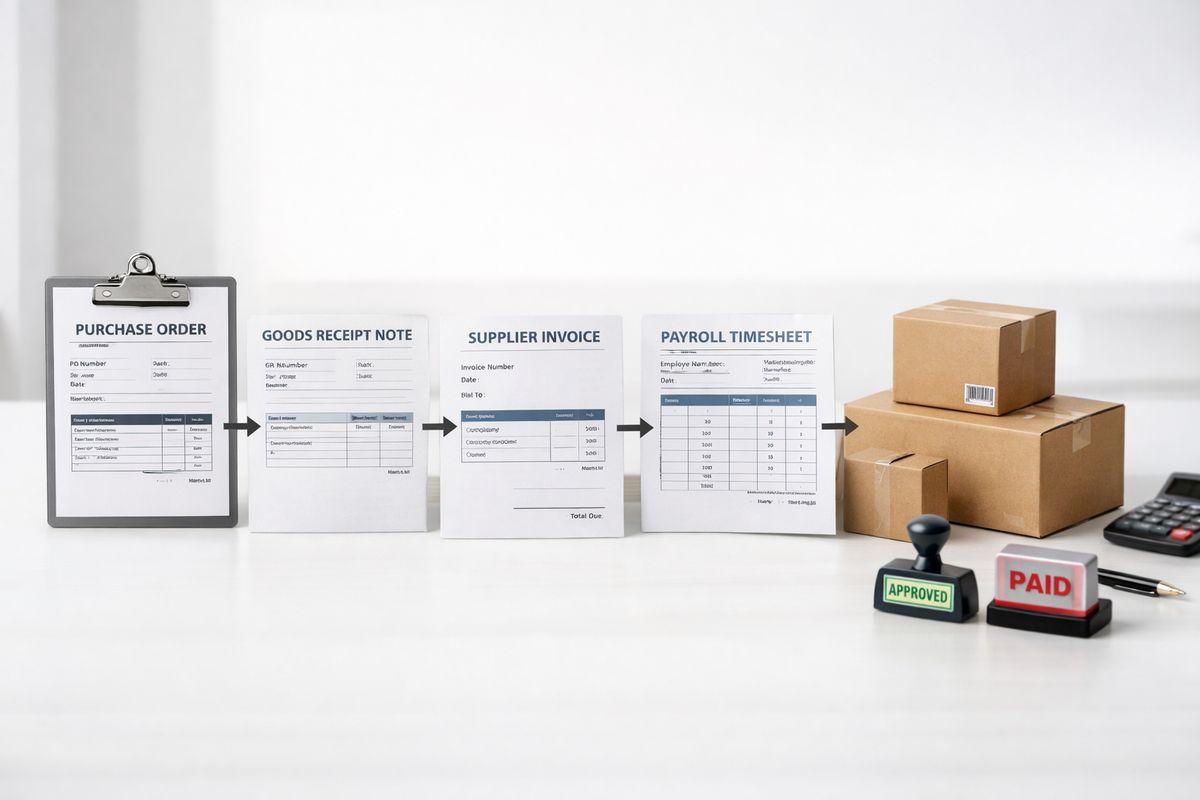
Finance automation is broader than bookkeeping and broader than accounts payable. It covers the entire chain from operational event to financial result. A purchase order becomes a supplier invoice. A site timesheet becomes payroll cost. A completed delivery becomes revenue. A stock movement changes margin. If those handoffs are disconnected, your finance data is delayed and your operational decisions are weaker.
That is why the strongest setups combine accounting, procurement, sales, stock, payroll, approvals, and management reporting in one connected model. Cloud platforms such as Xero can sit at the centre of that model, but only if surrounding workflows are integrated properly.
Core Processes You Should Connect First
Start with the processes where operational activity directly drives cash flow and control. Accounts payable sits near the top because invoices, approvals, supplier records, and payment timing affect spend discipline immediately. Accounts receivable is just as important because billing delays, disputes, and poor allocation hit cash collection fast.
Reconciliation and month-end close also deserve early attention. Manual reconciliations consume hours, create risk, and hold back reporting. Expense management, payroll, procurement, order-to-cash, and management reporting all belong in the same conversation because each one depends on timely, accurate operational inputs.
The pattern is simple: automate the transaction flow, connect the source data, and make exceptions visible.
The Technology Stack Behind Connected Automation
The right stack usually combines cloud accounting or ERP, workflow orchestration, document capture, integrations, and live dashboards. Rule-based automation handles repetitive tasks such as invoice routing, coding rules, approvals, reconciliations, and payment matching. AI-led automation handles the harder layer: classification, anomaly detection, forecasting, and exception handling.
That distinction matters. Rules are excellent for known scenarios. AI becomes valuable when invoices arrive in mixed formats, behaviour changes, or patterns need interpretation. Research shows AI and machine learning adoption is accelerating because finance teams want better prediction and faster decisions, not just faster keystrokes.
The Business Case: Real-Time Visibility, Faster Decisions, Stronger Control
Efficiency is the obvious win, but it is not the main one. The real value is control. Connected automation gives you live visibility over payables, receivables, budgets, approvals, and exceptions. That changes how you run the business day to day.
Instead of waiting for month-end reports, you can see spend against budget now. Instead of finding approval gaps during an audit, you can enforce policy at the point of transaction. Instead of asking finance to rebuild numbers manually, you can work from live dashboards.
For businesses working with /services/real-time-accounting models, this is where finance becomes operational. Cash flow, profitability, and KPI visibility stop being retrospective reports and become management tools.
Financial Gains You Can Measure
Good automation earns its place with numbers. Cost per invoice falls because data entry, chasing approvals, and correcting errors disappear. Processing time drops. Exception rates become visible. Close cycles shrink. DSO improves when order, invoice, and collection workflows are linked properly.
Finance leaders increasingly judge success through hard operational KPIs, including cost per invoice, cycle time, error rate, and exception rate. That is the right standard. If your automation project cannot show measurable impact, it is just software spend. For a sharper framework on this point, look at how to prove financial returns from automation.
Operational Gains Your Teams Will Feel Daily
The daily gains are just as valuable because they remove friction across departments. Approvals move without chasing. Documents stop disappearing in inboxes. Operations and finance work from the same data. Handoffs are cleaner. Managers see what is waiting, what is overdue, and what is outside policy.
This improves execution far beyond finance. Procurement buys with budget context. Operations sees supplier and project cost status earlier. Commercial teams invoice faster because delivery and billing are linked. Your whole business moves with less drag.
Where Automation Delivers the Fastest Impact
Do not start everywhere. Start where friction is high, volume is steady, and control matters immediately.
Accounts Payable and Procurement Control
This is often the quickest win. Invoice capture, three-way matching, approval routing, supplier records, spend limits, and payment scheduling belong in one controlled process. AI-powered AP tools now support touchless routing and validation, while still surfacing exceptions for review. The result is fewer duplicate payments, cleaner audit trails, better fraud resistance, and stronger cash planning.
This is also where many businesses discover the value of working with a partner such as Prodyssey Solutions and its /services/business-transformation approach. The software matters, but the workflow design matters more.
Order-to-Cash and Revenue Visibility
Revenue control improves fast when quotes, orders, invoicing, collections, and payment matching are connected. Billing goes out sooner. Disputes drop because finance can see fulfilment and documentation. Collections improve because unpaid items are visible by customer, ageing, and operational status.
This matters even more in project-based and field environments. If job progress, timesheets, materials, and billing are disconnected, margin leakage becomes inevitable. Tools such as Remato help connect field activity with office control, which is exactly what growing operational businesses need.
Close, Reconciliation, and Management Reporting
Month-end close is where manual finance pain becomes visible. Reconciliations drag, journals pile up, and reports arrive after decisions have already been made. Automation changes that by standardising journals, reducing matching effort, and feeding dashboards continuously.
The benchmark matters here. Many companies still take days to close, and the gap between average and top-performing finance teams is significant. Faster close is not just a finance vanity metric. It means management acts on current numbers, not stale ones.
How to Implement Finance Operations Automation Without Creating New Complexity
Automation fails when it starts with tools instead of processes. You do not need more software silos. You need a governed rollout that simplifies how work moves.
Start With Process Mapping and KPI Baselines
Map the current workflow before touching technology. Document every handoff, every approval, every spreadsheet, every manual correction, every rekeying point. Then set baseline metrics: cycle time, cost per transaction, error rate, exception volume, close days, overdue approvals.
That baseline becomes your control point. Without it, you cannot measure improvement or spot a bad rollout. It also exposes broken processes before you automate them, which prevents one of the most common and costly implementation failures that slow teams down.
Choose Systems That Connect, Not Just Automate
Selection criteria should be strict: integration with accounting and operational systems, cloud access, role-based approvals, audit trails, dashboard visibility, explainability, and scalability across entities or locations. Point solutions that automate one task but create a new silo do more harm than good.
This is where platforms designed around connected control stand out. Prodyssey Solutions builds finance and operations visibility around live workflows, not isolated software features.
Roll Out in Phases With Clear Ownership
Start with one high-friction workflow, usually AP, procurement, or close. Test normal transactions, then test exceptions. Train managers on approvals. Give finance ownership of policy and control. Give operational managers ownership of timely action. Then expand into adjacent processes once the first workflow is stable.
Adoption is part of implementation, not a separate phase. If managers bypass the system, automation fails. If exceptions are ignored, automation fails. If ownership is vague, automation fails.
Risks, Compliance, and Governance You Need to Build In From Day One
Automation without governance is just faster disorder. Finance workflows must be compliant, reviewable, and policy-driven from the start.
Compliance, Audit Trails, and Explainability
Your workflows should support GDPR, IFRS, tax documentation, approval logs, and segregation of duties by design. Every automated step must be traceable. Every exception must be reviewable. Every AI-based decision must be explainable.
That is not theoretical. Finance leaders now rank accuracy above speed because trust, compliance, and auditability carry more value than raw throughput.
Common Failure Points to Avoid
The biggest mistakes are predictable: automating broken processes, relying on poor data, underestimating user adoption, skipping exception handling, keeping spreadsheets as the shadow system, and assuming internal skills will somehow catch up later. Research consistently shows lack of internal expertise blocks progress.
You avoid those risks with clear governance, clean data ownership, phased delivery, and systems built for visibility.
Finance and Operations Automation in Cyprus and Greece
Businesses in Cyprus and Greece face a practical version of this challenge. Multi-entity structures, growing transaction volumes, tax and reporting demands, cross-border trade, and distributed teams all put pressure on finance control. Hiring larger back-office teams is not the answer. Connecting finance and operations is.
What SMBs and Growing Groups Need Most
You need cloud access across locations, stronger reporting discipline, and workflows that support multiple entities, currencies, and operational units without manual work multiplying at every step. You need finance visibility that reaches into day-to-day operations, not just statutory reporting.
That is exactly where connected accounting, workflow automation, and dashboards create an advantage. The goal is lean control, not a heavy admin layer.
What Good Looks Like in a Connected Finance Function
Good looks simple. Live dashboards. Clean approvals. Faster close. Reliable KPIs. Linked finance and operations data. Fewer manual interventions. Better cash visibility. Stronger budget control.
That end-state is achievable when business, finance, and technology work as one. If you want finance to stop reporting the past and start controlling the present, connected automation is the next move.
Leave a Reply