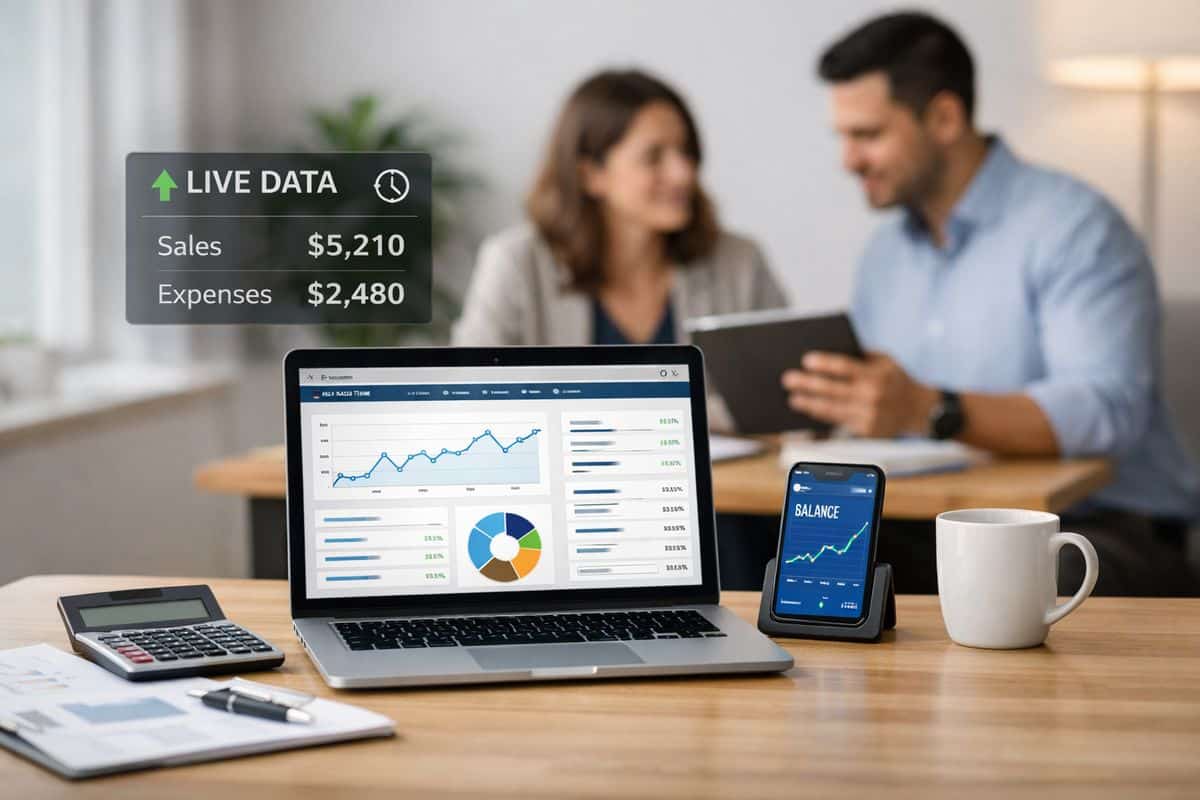
If your finance team still works to a month-end timetable, your business runs on stale information. Real time accounting for SMEs changes that by turning accounting into a live control system, giving you current visibility over cash, margins, liabilities, and performance. The real question is not whether the technology exists. It does. The question is whether your business is ready to turn that visibility into better control and stronger returns.
What Real-Time Accounting Means for Your SME
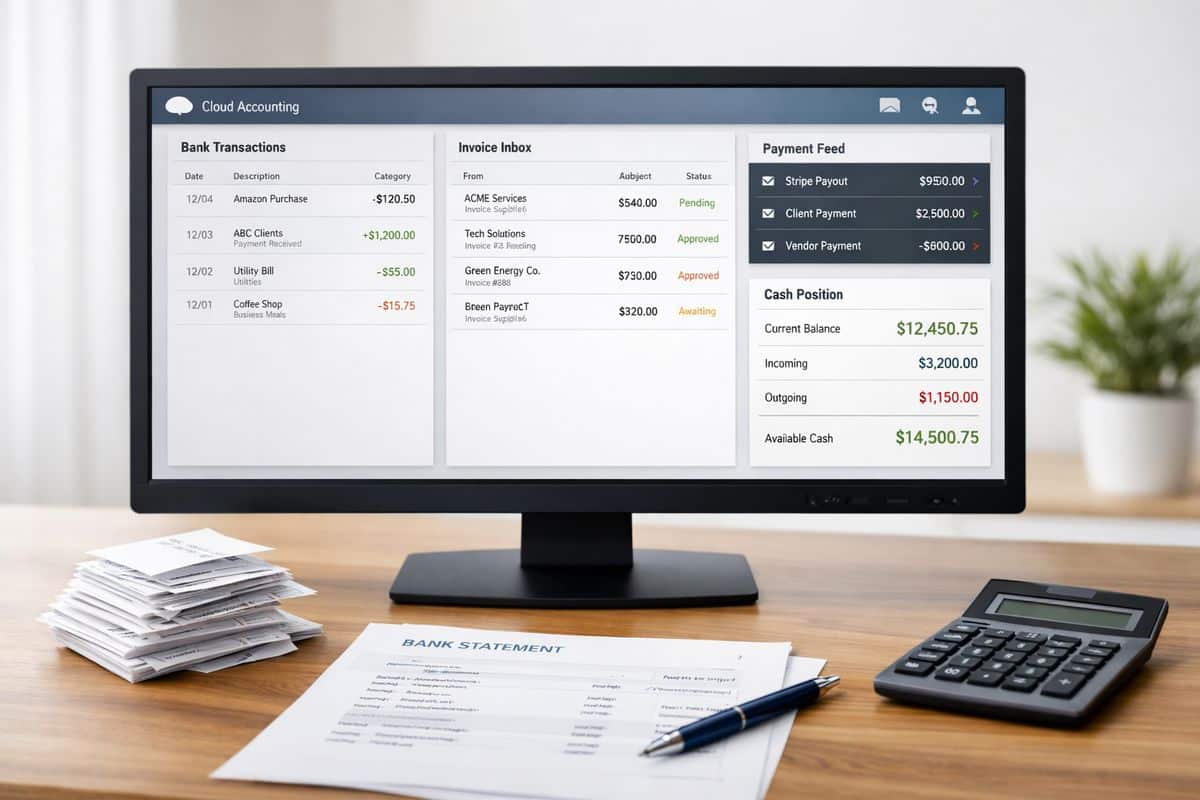
Real-time accounting means your financial records update continuously, not weeks after the fact. Bank feeds pull in transactions automatically. Invoice capture tools post data into the ledger. Payment platforms sync collections and disbursements. Dashboards refresh as activity happens, so you can see receivables, payables, cash position, and key KPIs without waiting for finance to “close the month”.
That is the operational difference. Traditional accounting tells you what happened. Real-time accounting shows you what is happening.
For an SME, that changes the role of finance completely. Accounting stops being a backward-looking compliance exercise and becomes a live business control system. That is the model Prodyssey Solutions builds towards: connected finance, systems, and operations that give you one usable view of the business.
Real-Time vs Traditional Accounting Cycles
Traditional cycles create delay by design. Transactions sit unreconciled. Supplier invoices wait in inboxes. Accruals and corrections pile up until month end. By the time reports land on your desk, the issue has already done damage.
Real-time accounting spreads the workload across the period. Reconciliation happens daily. Exceptions are flagged early. Management accounts become faster to produce because much of the underlying work is already done. Sage describes this as continuous accounting, and the appeal is obvious: less bottleneck at month end, less firefighting, and more control during the month when decisions still matter.
If delayed reporting is already slowing your decisions, it helps to understand exactly why month-end routines create drag. The pattern is familiar: finance becomes busiest when management needs answers fastest.
The Systems Behind Real-Time Visibility
This is not a single software purchase. It is an operating model built on connected tools and disciplined processes.
At the centre sits cloud accounting software. Around it sit bank feeds, invoice capture, expense tools, payment gateways, stock or ERP integrations, payroll data, and reporting dashboards. AI now plays a practical role as well, especially in invoice extraction, transaction coding, anomaly detection, and forecasting. In the accounting AI market, cloud deployment already holds the dominant share, which tells you where the market has settled.
The best setups connect source systems properly instead of relying on CSV exports and manual rekeying. That matters because live dashboards are only as good as the data flowing into them.
Where the Business Value Shows Up Fastest
The value shows up where delay used to hurt you most: cash, reporting speed, and management control. You do not buy real-time accounting to admire cleaner software. You buy it to run the business faster and with fewer blind spots.
For most SMEs, the first gains come from tighter cash management and reduced manual work. Then the second-order benefits appear: quicker decisions, fewer reporting disputes, and cleaner KPI tracking across departments.
Cash Flow, Working Capital, and Live Control
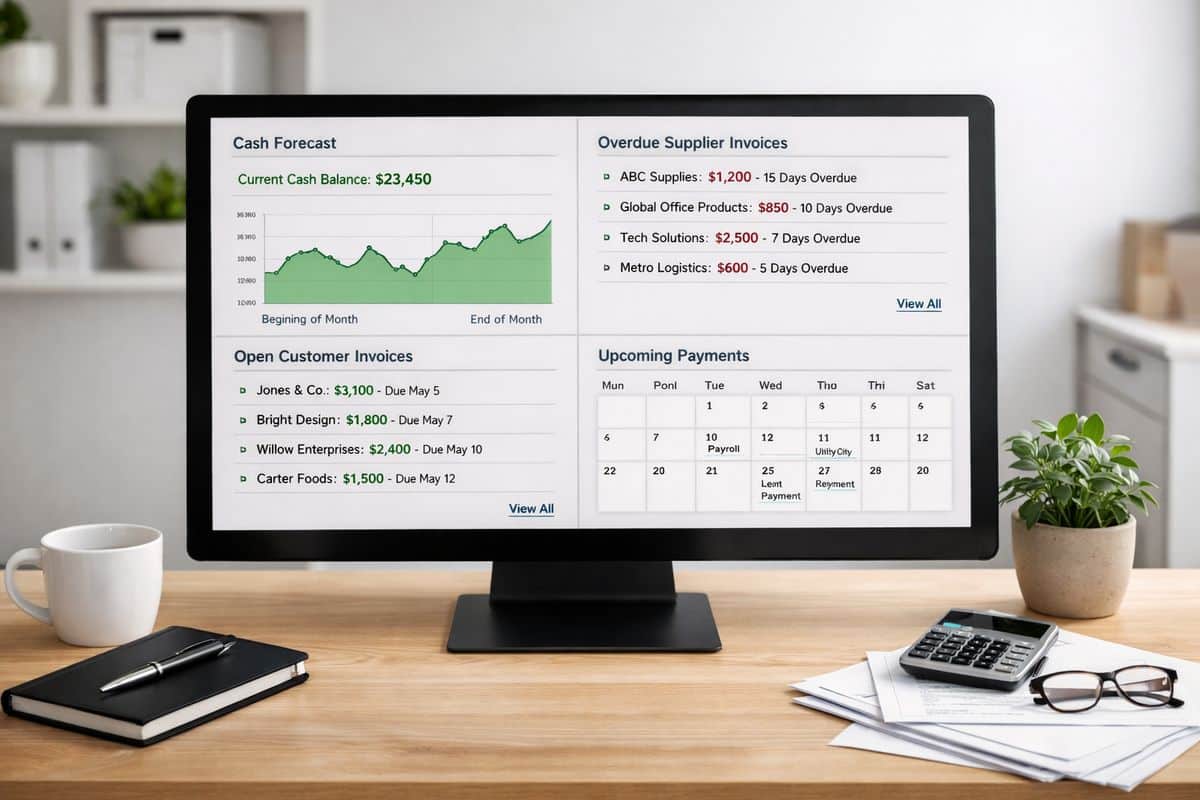
Cash flow is where real-time accounting earns its place fastest. With current receivables, payables, and bank data in one view, you can see pressure building before it becomes a crisis. You can chase overdue accounts sooner, sequence supplier payments more deliberately, and avoid making decisions based on a bank balance that hides upcoming liabilities.
That matters because demand for real-time cash-flow dashboards is now a major growth driver in SME finance technology. Businesses want current cash visibility because it affects everything: funding decisions, stock purchases, hiring, project timing, and dividend discipline.
The upside is measurable. Early adopters of AI-native cash tools reduced idle cash balances by 12% on average while also avoiding overdraft fees. That is not cosmetic efficiency. That is direct working-capital improvement. If cash control is already a pressure point, a deeper look at why live cash visibility changes decisions makes the case quickly.
Faster Close, Fewer Manual Tasks, Better KPI Tracking
Manual accounting work is expensive twice over. You pay for the labour, then you pay again in delay. Real-time accounting strips out much of that drag through automated bank matching, invoice capture, approval routing, and exception handling.
The technology has matured. Invoice tools now achieve 95%+ accuracy in extracting key fields from invoices, receipts, and contracts, and early adopters have reported a 30% reduction in processing times. That gives your finance function more time for review, analysis, and action instead of data entry.
The benefit carries through to KPI reporting. When transactions are coded promptly and reconciliations happen continuously, dashboards for margin, debtor days, project performance, or location profitability stop lagging behind operations. If you want those dashboards to drive action rather than decoration, focus on the metrics worth monitoring before you build the reporting layer.
What It Costs , and What Determines Whether It Pays Back
Real-time accounting is not free, and the business case should be tested properly. Costs sit across software subscriptions, implementation, integrations, process redesign, training, and ongoing support. If you ignore those elements, the project looks cheaper than it is. If you measure them against labour saved, delays removed, and control gained, the economics usually become clearer.
Cloud delivery improves the picture because it reduces upfront investment and scales more easily. That is one reason cloud-based close software continues to take the largest market share.
The Main Cost Drivers
The biggest cost driver is complexity. A single-entity services business with clean workflows costs far less to modernise than a multi-entity group with stock, projects, approval hierarchies, and cross-system data flows.
Entity count matters. User count matters. Integration depth matters. Compliance requirements matter. If your processes are inconsistent or heavily manual, redesign work becomes a real part of the budget. The same applies if your team needs role-based dashboards, custom approval paths, or detailed reporting by product line, branch, or project.
External support also changes the economics. The right implementation partner shortens the route to value. The wrong one leaves you with expensive software and manual workarounds.
When Real-Time Accounting Delivers Strong ROI
The strongest returns appear when finance complexity has already outgrown your current setup. High transaction volumes, rapid growth, multi-entity structures, project accounting, stock-heavy operations, and tight working-capital demands all justify investment quickly.
You also see strong ROI when finance headcount is under pressure. Automation absorbs repetitive tasks. Continuous reconciliation reduces month-end crunch. Management gets answers faster, which improves operational control outside finance as well.
This is why SMEs are not just dabbling here. They are the fastest-growing segment in AI accounting adoption. The return is strongest where delay, fragmentation, and manual effort already cost you money every month.
The Risks, Limits, and Common Buying Mistakes
Real-time accounting is powerful, but it is not magic. If your processes are weak, permissions are loose, and ownership is unclear, live data simply gives you faster confusion.
That is the catch. Better visibility only creates value when the business is set up to act on it.
Real-Time Data Does Not Fix Poor Decision-Making
Access to current numbers does not automatically produce better decisions. Research on cloud accounting found that 62.4% disagreed that real-time data access alone improves managerial decision-making. That result rings true in practice.
Dashboards need clear KPIs. KPIs need ownership. Ownership needs review routines. If nobody is accountable for debtor days, gross margin drift, stock variance, or project overspend, live dashboards become background noise.
Real-time accounting works when management discipline catches up with data speed.
Security, Compliance, and Integration Gaps
Security concerns are legitimate, especially when finance data moves into cloud platforms and connected apps. You need role-based access, audit trails, approval controls, and proper segregation of duties. You also need confidence that tax treatment, digital record keeping, and e-invoicing requirements are handled correctly in your jurisdiction.
Integration gaps cause a different type of risk. If inventory, CRM, payroll, point-of-sale, or project systems do not sync properly, your “real-time” view becomes partial and misleading. That is worse than a delayed report because it looks current while remaining incomplete.
The strongest providers deal with both issues together: control and connectivity.
Mistakes to Avoid When Choosing a Provider
The most damaging buying mistakes are predictable. Buying for features instead of use case is common. So is underestimating change management. Another failure point is accepting manual workarounds in a project that is supposed to reduce manual work.
A weak provider also focuses too narrowly on bookkeeping. Real-time accounting sits across finance, operations, and systems. If your provider cannot connect data sources, design usable dashboards, and support process change, the implementation stalls after the demo.
Is It Worth It for Your Business? A Practical Decision Framework
For many SMEs, yes, it is worth it. But only when the investment solves a real control problem and your team is ready to use the system properly. Buy based on operational need, not software fashion.
Signs Your SME Is Ready Now
Your business is ready when month-end closes are too slow, cash visibility is patchy, transaction volume is rising, and finance relies on spreadsheets to bridge disconnected systems. You are also ready when growth has exposed the limits of a basic bookkeeping setup, or when your finance team spends more time chasing data than analysing it.
Those are not minor irritations. Those are signals that your current model has hit capacity.
When a Lighter Setup Is Enough
Not every business needs full real-time capability straight away. If transaction complexity is low, reporting needs are simple, cash cycles are stable, and management already has clear control over the numbers, a lighter cloud setup with basic automation is enough.
That is also true if your finance basics are still weak. If coding discipline, chart of accounts structure, or approval controls are inconsistent, fix those first. Real-time reporting built on poor foundations simply produces faster mess.
What to Look for in an Accounting Partner or Service Provider
Choose a partner that understands more than ledger maintenance. You need implementation support, integration capability, dashboard design, automation expertise, security discipline, and sector understanding. You also need advisory input after go-live, because the point is not to install software. The point is to improve control.
That is where the right partner earns value. Strong providers connect finance with operations, simplify reporting, and turn current data into usable decisions. For businesses in Cyprus and abroad, Prodyssey Solutions positions real-time accounting exactly that way: not as faster bookkeeping, but as a connected operating model for better control.
If your business is still managing by hindsight, the answer is simple. Real-time accounting is worth it when delayed information already costs you speed, cash, and confidence. In that situation, staying traditional is the more expensive choice.
Leave a Reply